
When you start your journey in the stock market, you’ll often hear experienced investors talking about blue-chip stocks. These stocks form the backbone of many investment portfolios and are considered the gold standard for long-term wealth building. Understanding what blue-chip stocks are and why they matter can help you make smarter investment decisions and build a more stable financial future.
What Are Blue-Chip Stocks?
Blue-chip stocks represent shares of large, well-established companies that have operated successfully for many years. These companies are typically household names that you encounter in your daily life. Think of companies like Apple, Microsoft, Coca-Cola, or Johnson & Johnson. The term “blue-chip” comes from poker, where blue chips traditionally hold the highest value.

These stocks belong to companies with strong financial foundations, proven business models, and a track record of weathering economic storms. They usually have market capitalizations in the billions of dollars and are often included in major stock market indices like the Dow Jones Industrial Average or the S&P 500.
Meaning in Simple Terms
The blue-chip stocks meaning refers to stocks of companies that are leaders in their industries, have stable earnings, and maintain strong balance sheets. These companies have demonstrated their ability to generate consistent profits over decades, even during challenging economic periods.
Key characteristics that define blue-chip stocks include:
- Large market capitalization (usually over $10 billion)
- Consistent dividend payments to shareholders
- Strong brand recognition and market presence
- Stable revenue streams across multiple business segments
- Professional management with proven leadership
- Regular inclusion in major stock indices
Why Invest in Blue-Chip Stocks?
There are several compelling reasons why invest in blue-chip stocks should be part of your investment strategy:
Stability and Reliability: Blue-chip companies have survived multiple economic cycles, recessions, and market downturns. This resilience makes them more reliable investments compared to smaller, newer companies that might struggle during tough times.
Dividend Income: Many blue-chip stocks pay regular dividends, providing you with a steady income stream. These dividends often increase over time, helping you combat inflation and grow your wealth even when stock prices remain flat.
Lower Volatility: While all stocks experience price fluctuations, blue-chip stocks tend to be less volatile than smaller company stocks. This means fewer dramatic price swings that could cause stress or prompt emotional investment decisions.
Liquidity: Blue-chip stocks are heavily traded, meaning you can easily buy or sell them when needed. This liquidity ensures you won’t get stuck holding shares you can’t sell quickly.
Growth Potential: Despite their large size, many blue-chip companies continue to grow and innovate, offering potential for capital appreciation alongside dividend income.
Importance in Your Portfolio
The importance of blue-chip stocks cannot be overstated when building a well-rounded investment portfolio. These stocks serve several crucial functions:
Portfolio Foundation: Blue-chip stocks act as the foundation of your investment portfolio. They provide stability that allows you to take calculated risks with other investments. Think of them as the solid base of a pyramid that supports everything else you build on top.
Risk Management: By including blue-chip stocks in your portfolio, you reduce overall investment risk. These stocks help balance out the volatility that might come from investing in smaller, more speculative companies.
Inflation Protection: Many blue-chip companies have pricing power, meaning they can raise prices for their products or services to keep up with inflation. This ability helps protect your investment’s purchasing power over time.
Wealth Preservation: For investors approaching retirement or those who need to preserve wealth, blue-chip stocks offer a way to maintain purchasing power while still participating in market growth.
Blue-Chip Stocks for Beginners: Getting Started
If you’re new to investing, blue-chip stocks for beginners represent an excellent starting point. Here’s why they’re perfect for newcomers:
Easy to Research: Information about blue-chip companies is readily available. These companies file regular reports, hold earnings calls, and receive extensive media coverage, making it easier for beginners to understand their business operations.
Less Risky Learning Environment: Starting with blue-chip stocks allows beginners to learn about stock market investing without taking excessive risks. You can observe how these stocks behave during different market conditions and gain valuable experience.
Simple Investment Strategy: A basic strategy of buying and holding blue-chip stocks can be very effective for beginners. You don’t need complex trading strategies or constant monitoring of your investments.
Educational Value: By following blue-chip companies, beginners can learn about different industries, business models, and economic factors that affect stock prices.
Examples Stocks
Understanding examples of blue-chip stocks helps illustrate what makes a company qualify for this prestigious category:

Technology Sector: Apple (AAPL), Microsoft (MSFT), and IBM have dominated the technology landscape for decades. These companies continue to innovate while maintaining strong financial positions.
Consumer Goods: Procter & Gamble (PG), Coca-Cola (KO), and PepsiCo (PEP) produce everyday products that consumers buy regardless of economic conditions. Their brands are recognized worldwide.
Healthcare: Johnson & Johnson (JNJ), Pfizer (PFE), and Merck (MRK) represent the pharmaceutical and healthcare industry. These companies benefit from aging populations and continuous demand for healthcare products.
Financial Services: JPMorgan Chase (JPM), Bank of America (BAC), and Berkshire Hathaway (BRK.A) represent the financial sector’s blue-chip stocks.
Industrial Sector: General Electric (GE), Boeing (BA), and Caterpillar (CAT) have been industrial leaders for generations.
These companies have proven their ability to generate profits consistently and return value to shareholders through dividends and stock price appreciation.
Are These Stocks Safe?
A common question among investors is: are blue-chip stocks safe? While no investment is completely risk-free, blue-chip stocks are generally considered among the safest stock investments available.
Relative Safety: Blue-chip stocks are safer than most other types of stocks because of their established business models, diverse revenue streams, and strong financial positions. However, they still carry market risk and can lose value during economic downturns.
Not Risk-Free: It’s important to understand that “safer” doesn’t mean “safe.” Blue-chip stocks can still experience significant price declines during market corrections or recessions. For example, even strong companies saw their stock prices fall substantially during the 2008 financial crisis and the 2020 pandemic.
Company-Specific Risks: Individual blue-chip companies can face challenges that affect their stock prices. Changes in consumer preferences, technological disruption, or management problems can impact even the strongest companies.
Market Risk: All stocks, including blue-chips, are subject to overall market movements. When the entire stock market declines, blue-chip stocks typically fall as well, though often less severely than smaller companies.
Best Blue-Chip Stocks 2025: Current Considerations
When evaluating the best blue-chip stocks 2025, investors should consider several factors that make certain companies particularly attractive in the current environment:
Technology Leaders: Companies that have successfully adapted to digital transformation continue to show strong potential. Microsoft and Apple remain leaders due to their cloud computing services, subscription models, and innovative products.
Healthcare Innovation: Healthcare companies developing new treatments, especially those involved in biotechnology and personalized medicine, represent attractive blue-chip opportunities.
Sustainable Business Models: Companies focusing on environmental sustainability and renewable energy are positioning themselves for long-term success as the world shifts toward cleaner technologies.
Dividend Aristocrats: Blue-chip stocks that have increased their dividends for 25 consecutive years or more deserve special attention. These companies have proven their commitment to returning value to shareholders.
Global Reach: Companies with international operations and diverse geographic revenue streams are better positioned to capitalize on global economic growth.
Long-Term Benefits of Blue-Chip Stocks
The long-term benefits of blue-chip stocks make them essential components of wealth-building strategies:
Compound Growth: Over long periods, blue-chip stocks have historically provided solid returns through a combination of dividend payments and capital appreciation. The power of compounding makes these returns even more significant over time.
Dividend Growth: Many blue-chip companies regularly increase their dividend payments, providing investors with growing income streams that can keep pace with or exceed inflation.
Wealth Building: Despite periods of volatility, blue-chip stocks have historically been effective wealth-building tools. Investors who hold diversified portfolios of blue-chip stocks for decades often see substantial growth in their investments.
Retirement Planning: Blue-chip stocks play a crucial role in retirement planning by providing both growth potential during accumulation years and income potential during retirement years.
Generational Wealth: The stability and growth potential of blue-chip stocks make them suitable for long-term wealth preservation and transfer to future generations.
Difference Between Blue-Chip and Penny Stocks
Understanding the difference between blue-chip and penny stocks is crucial for making informed investment decisions:
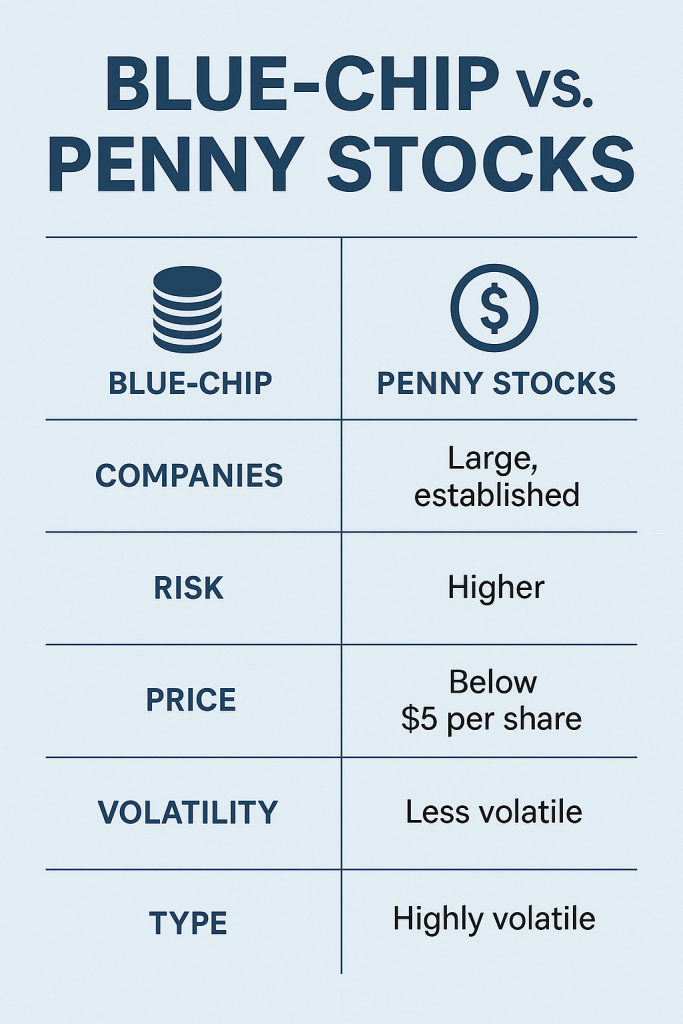
Company Size and Maturity: Blue-chip stocks represent large, established companies with proven track records, while penny stocks typically represent small, often struggling companies with uncertain futures.
Price and Volatility: Blue-chip stocks usually trade at higher prices and experience less dramatic price swings. Penny stocks, as their name suggests, trade at very low prices (often under $5 per share) and can experience extreme volatility.
Risk Levels: Blue-chip stocks carry lower risk due to their established business models and financial stability. Penny stocks are highly speculative investments with significant risk of total loss.
Liquidity: Blue-chip stocks are heavily traded and easy to buy or sell quickly. Penny stocks often have low trading volumes, making them difficult to sell when you want to exit your position.
Information Availability: Blue-chip companies provide extensive financial information and regular updates to investors. Many penny stock companies provide limited information, making them difficult to analyze.
Investment Approach: Blue-chip stocks are suitable for long-term investing and wealth building. Penny stocks are often used for speculation and short-term trading, though this approach carries significant risks.
Building Your Blue-Chip Investment Strategy
Creating a successful blue-chip investment strategy involves several key steps:
Diversification: Don’t put all your money into one blue-chip stock or even one sector. Spread your investments across different industries to reduce risk.
Dollar-Cost Averaging: Consider investing a fixed amount regularly rather than trying to time the market. This approach helps smooth out price fluctuations over time.
Dividend Reinvestment: Many blue-chip stocks offer dividend reinvestment plans (DRIPs) that automatically use your dividend payments to purchase additional shares, accelerating your wealth building.
Regular Review: While blue-chip stocks are suitable for long-term holding, it’s important to review your holdings periodically to ensure they still meet your investment criteria.
Tax Considerations: Understand the tax implications of your blue-chip investments, particularly regarding dividend income and capital gains.
Conclusion
Blue-chip stocks represent some of the best opportunities for building long-term wealth in the stock market. Their combination of stability, dividend income, and growth potential makes them suitable for investors of all experience levels. While they’re not without risk, their proven track records and strong financial foundations make them considerably safer than most other stock investments.
Whether you’re a beginner just starting your investment journey or an experienced investor looking to add stability to your portfolio, blue-chip stocks deserve serious consideration. By understanding what makes these companies special and how they can benefit your financial future, you’ll be better equipped to make investment decisions that support your long-term goals.
Remember that successful investing requires patience, discipline, and continuous learning. Blue-chip stocks provide an excellent foundation for building wealth, but they work best as part of a diversified investment strategy tailored to your individual financial situation and goals.