State-wise maternal healthcare schemes: Karnataka vs Tamil Nadu – Dive into a comprehensive 2025 update comparing Karnataka’s and Tamil Nadu’s maternal health programs, successes, challenges, and future strategies.
Introduction to Maternal Healthcare in India
Maternal healthcare is a cornerstone of public health in India. With over 27 million births annually, ensuring the safety and well-being of mothers is a national priority. From prenatal care to postnatal support, India’s health system is evolving rapidly to meet the needs of expecting mothers. Both central and state governments contribute through specialized schemes aimed at reducing maternal mortality rates (MMR), improving institutional deliveries, and enhancing overall maternal well-being.
The Sustainable Development Goal (SDG) 3.1 aims to reduce global maternal mortality to less than 70 per 100,000 live births by 2030. India, too, has committed to this goal, making maternal health a key focus area.
Why Compare Karnataka and Tamil Nadu?
Karnataka and Tamil Nadu stand out for their proactive maternal health policies. While Tamil Nadu has historically been a pioneer in health indicators, Karnataka has made significant strides in recent years. Comparing these two states offers a lens into how diverse administrative approaches yield unique outcomes.
- Geographical similarity: Both states are located in southern India with similar demographics.
- Policy divergence: Their approach to maternal health delivery varies in funding, implementation, and innovations.
- Performance metrics: Tamil Nadu often leads in institutional deliveries, while Karnataka excels in digital health integration.
Maternal Health Indicators: A Quick Snapshot
| Indicator | Karnataka | Tamil Nadu |
|---|---|---|
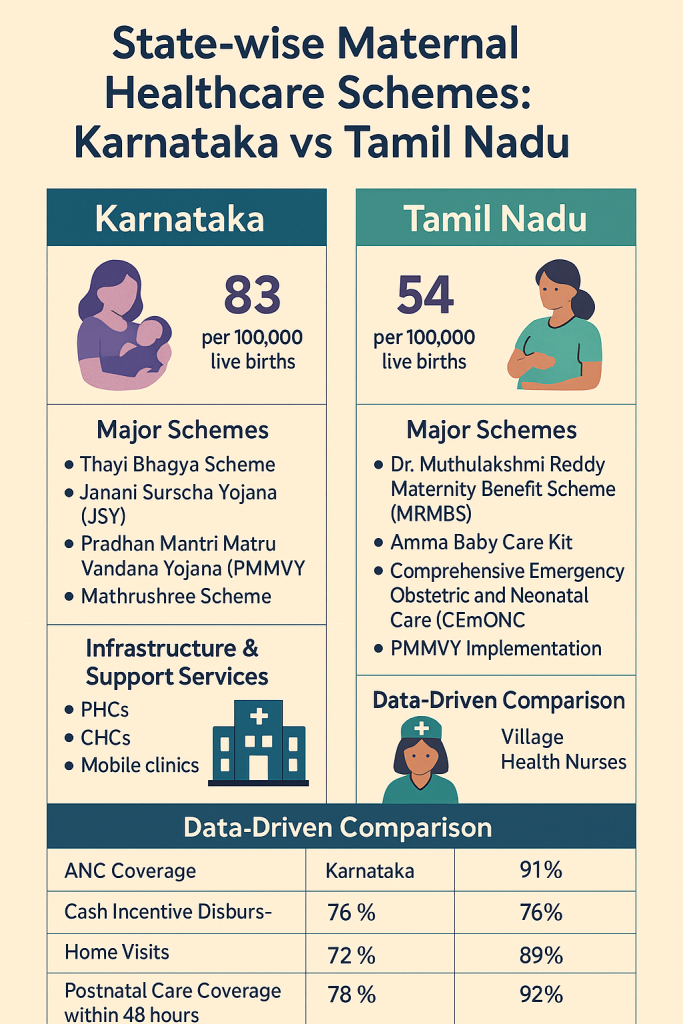
| Maternal Mortality Ratio (MMR) | 83 per 100,000 live births | 54 per 100,000 live births |
| Institutional Delivery Rate | 96% | 99% |
| ANC (Antenatal Care) Coverage | 91% | 98% |
| Postnatal Care within 48 hours | 78% | 92% |
Tamil Nadu consistently outperforms Karnataka, particularly in postnatal care and maternal mortality. Yet, Karnataka is catching up through targeted schemes.
Major Maternal Health Schemes in Karnataka
1. Thayi Bhagya Scheme: Offers free maternity services, diagnostics, and transport to BPL women.
2. Mathrushree Scheme: Provides ₹6,000 in cash incentives in three installments during pregnancy to BPL women.
3. Janani Suraksha Yojana (JSY): Promotes institutional delivery through cash assistance, integrated with national programs.
4. PMMVY: ₹5,000 cash benefit to pregnant women for their first child, promoting antenatal care.
Infrastructure & Support Services
Karnataka has focused on strengthening rural infrastructure:
- 2,700+ Primary Health Centers (PHCs)
- 200+ Community Health Centers (CHCs)
- Introduction of mobile health clinics and telemedicine services
Tamil Nadu’s Maternal Healthcare Framework
Tamil Nadu is often recognized as a model state for maternal care. The state adopted a holistic, decentralised approach with strong community engagement.
Flagship Maternal Health Programs in Tamil Nadu
- Dr. Muthulakshmi Reddy Maternity Benefit Scheme: ₹18,000 distributed over multiple stages to ensure nutrition and check-ups.
- Amma Baby Care Kit: Free kits for mothers post-delivery, containing hygiene and newborn essentials.
- CEmONC Centers: Specialized facilities offering 24/7 emergency obstetric and neonatal care.
- PMMVY: Seamlessly integrated into state platforms, increasing coverage and reducing duplication.
Community & Technological Interventions
- Village Health Nurses (VHNs) conduct regular home visits and community-level care.
- e-Health and m-health apps track ANC, nutrition, and immunizations.
- Use of Mother-Child Protection Cards and biometric tracking for follow-up
Funding, Budget Allocation, and Resource Utilization
Both Karnataka and Tamil Nadu have consistently allocated dedicated resources to maternal healthcare. However, Tamil Nadu’s prioritized maternal budget planning and integration of vertical programs have yielded better results in terms of outreach and effectiveness.
| State | FY 2023-24 Maternal Health Budget | Percentage of Health Budget | Fund Utilization Rate |
|---|---|---|---|
| Karnataka | ₹1,100 crore | 14% | 83% |
| Tamil Nadu | ₹1,300 crore | 18% | 94% |
Tamil Nadu’s higher utilization rate stems from better planning, fewer lapses in fund disbursal, and community-based health monitoring systems.
Role of NGOs and Civil Society in Both States
In both states, NGOs play a critical role in bridging gaps in awareness and last-mile service delivery.
Karnataka
- Swasthya Karnataka Foundation partners with PHCs for health camps and nutrition drives.
- Karuna Trust operates PHCs in tribal areas, focusing on maternal outreach.
Tamil Nadu
- Rural Women’s Social Education Centre (RUWSEC) contributes to maternal education and reproductive rights.
- Arghyam supports water, sanitation, and hygiene (WASH) projects to prevent infections post-delivery.
NGOs in Tamil Nadu benefit from strong state support and integration into district-level health planning.
Key Success Factors and Implementation Challenges
Success Factors:
- Tamil Nadu: Community engagement, early registration of pregnancies, 24/7 maternal facilities, and strong referral systems.
- Karnataka: Technology-driven care tracking (e.g., e-JanMa portal), mobile medical units, and increased PHC density.
Challenges:
- Karnataka: Disparities in tribal and backward districts, delays in fund disbursal.
- Tamil Nadu: Urban slum coverage gaps, overburdened frontline workers.
Voices from the Ground: Real Stories from Mothers
Latha from Tumakuru, Karnataka:
The Thayi Bhagya scheme helped me get all my check-ups for free. But the nearest PHC was still 20 km away. I had to rely on private transport in the final month.
Meena from Tiruchirappalli, Tamil Nadu:
I got ₹18,000 through the MRMBS, plus the Amma Baby Kit. Village nurses came home to check on me even after delivery. That care made all the difference.
These real-life experiences highlight how accessibility and outreach can make or break the system for rural women.
Data-Driven Comparison: Karnataka vs Tamil Nadu
| Category | Karnataka | Tamil Nadu |
|---|---|---|
| MMR (per 100,000 live births) | 83 | 54 |
| Institutional Deliveries (%) | 96 | 99 |
| ANC Registration within First Trimester (%) | 78 | 91 |
| Full Immunization of Mothers (%) | 80 | 95 |
| Home Visit within 48 hrs Post Delivery (%) | 72 | 89 |
| Cash Incentive Disbursement (%) | 76 | 93 |
Tamil Nadu scores higher across almost every major indicator, thanks to strong policy integration, workforce accountability, and targeted incentives.
What Can Other States Learn?
- From Karnataka:
- Leverage digital tools like e-JanMa and MatriMitra for pregnancy tracking.
- Invest in mobile health vans and telemedicine to serve remote areas.
- From Tamil Nadu:
- Ensure universal cash benefit access through simplified disbursement systems.
- Deploy community health workers at the village level for personal outreach.
- Focus on emergency care infrastructure like CEmONC centers in rural hospitals.
Both states offer replicable frameworks—Karnataka for tech-driven care, Tamil Nadu for human-centered models.
Government Roadmap Ahead (2025 and Beyond)
Both Karnataka and Tamil Nadu have drafted new maternal health action plans in line with SDG 2030. Key future goals include:
- Expanding teleconsultation services in tribal belts.
- Introducing AI-based risk prediction tools for high-risk pregnancies.
- Increasing budget allocation toward nutrition and mental health support post-delivery.
- Launching mother-infant bonding initiatives and postpartum wellness hubs.
These steps aim to reduce maternal and neonatal deaths further and ensure universal health coverage for all pregnant women.
Which state offers more comprehensive maternity benefits: Karnataka or Tamil Nadu?
Tamil Nadu currently offers more comprehensive and timely maternity benefits, including higher cash incentives, baby care kits, and better emergency care facilities.
Is PMMVY active in both Karnataka and Tamil Nadu?
Yes, the Pradhan Mantri Matru Vandana Yojana (PMMVY) is implemented in both states, but Tamil Nadu has integrated it more effectively with local schemes.
What’s unique about the Amma Baby Care Kit in Tamil Nadu?
It includes baby clothing, hygiene products, and essential items to reduce neonatal infections and ensure safe postnatal care.
How does Karnataka track maternal health digitally?
Through e-JanMa, a digital birth registration platform, and MatriMitra, which sends health updates and reminders via SMS to pregnant women.
Are there free transport services for pregnant women in either state?
Yes. Karnataka provides transport under the Thayi Bhagya scheme. Tamil Nadu offers ambulance services through the 108 Emergency Response System.
What challenges do both states still face?
Karnataka faces challenges in rural and tribal outreach. Tamil Nadu, while better performing overall, must address gaps in urban slum coverage and health worker fatigue.
Conclusion: Bridging the Maternal Health Gap
Karnataka and Tamil Nadu offer two successful, yet different, models of maternal care. While Tamil Nadu excels in human-led, community-supported healthcare, Karnataka is pushing boundaries with innovation and tech. Together, their experiences underline the importance of inclusive policy, consistent funding, frontline workforce support, and real-time monitoring.
Improving maternal health isn’t just about reducing deaths—it’s about empowering women, strengthening families, and building a healthier generation. As India marches toward 2030, these two states light the path for others to follow.