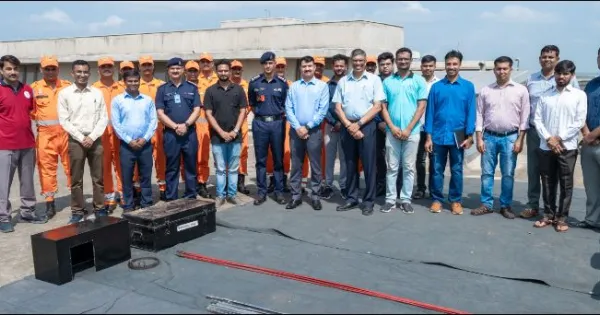

Gandhinagar. Indian Institute of Technology Gandhinagar recently assigned the Borewell rescue system developed by indigenous technology to the sixth battalion of the National Disaster Response Force (NDRF), Jarod, Vadodara. It is the first employee-defined project of IITGN, which has been developed by the institute itself. The project aims to make borewell rescue operations more secure and effective.
The Public Relations Department of the institution said in its statement that every year children in India fall into open borewells, causing complex challenges in front of the rescuers. The project aims to develop a improved borewell rescue system, with a controlled lifting mechanism instead of raising heavy and unstable rescue sticks (rods). It has the support of structural and operational reforms. The system was successfully verified in several mock tests and is now assigned to NDRF for field use.
The program began with the performance of the borewell rescue system, displaying old rescue methods and project reforms. The people present saw that the newly developed vinch and the hohyst mechanism facilitates controlled operations, causing a sufficient decrease in physical stress and risk in hand handling heavy metal rescue sticks while working in depth.
The details of the project’s visit were later presented through a presentation. It mentions the process ranging from the initial field visit to the final product development in NDRF Gandhinagar. The presentation also included the details of the problem, the collaborative design process and the details of several stages tests.
Professor Rajat Moona, director of IITGN, said, “I congratulate the team for developing this system independently and thanks Prof. Madhu Wadali for guidance. This system will reduce the manual labor of soldiers and increase the efficiency of prevention of controlled mechanisms. Such solutions can motivate our student community and show that institutions can help in solving national importance.”
NDRF Commandant, Surendra Singh said, “Earlier our military rescue sticks were handled by hand, causing them to get tired and increased. Now the wind-hurest system would bear the weight of both rod assembly and trapped person, which will reduce the need to work by hand. I thank IITGN employees and Prof. Madhu for this development.”
IITGN’s Mechanical Engineering Department, Prof. Vinod Narayanan congratulated the team for successfully developing the system under faculty guidance under the staff-led innovation project. He said, “I appreciate the efforts of the employees and congratulate that he created this system himself. Also, I thank Prof. Madhu Wadali for his guidance and inspiration.”
Director of IITGN, Prof. Silver Moona, NDRF Commandant, Surendra Singh; Pro. Vinod Narayanan (Head of Department, Mechanical Engineering), Prof. Madhu Wadali (Associate Professor and Project Mentor), Prof. Atul Bhargava (Professor, Mechanical Engineering) and the project staff team were present.
The project team consisted of Bablu Sharma, Ashish Pandey, Nirav Bhatt, Aman Tripathi, Praganesh Parekh and Mr. Shibram Sahu. His hard work and faculty guidance played an important role in design, ready and handing over to NDRF.